What is Mint Recursive
Mint Recursive is Mind Lab's managed platform for model post-training and inference across industries. It brings evaluation, data preparation, post-training, and deployment into one workflow. Through its API and Python SDK, you can run the whole cycle and bring feedback from production into the next round.
Improving a model takes a clear view of where it falls short, what changed after training, and whether the change holds up against the same evaluation. Mint Recursive organizes the work around these questions, so experience from a business can become something its models learn from.
Models and training methods
The platform supports models of different sizes from the GLM, Qwen, DeepSeek, Kimi, and MiniMax open-source families, as well as the Macaron V1 series. The platform's model list shows the versions currently available.
Training methods include supervised fine-tuning (SFT) and reinforcement learning (RL), with full-parameter training and LoRA available as ways to update model parameters. Choose a combination that fits your task, data, and resources.
How one round leads to the next
Start with a benchmark that reflects the work the model needs to do: a set of tasks and criteria for judging the results. Use it to find problems, then to compare the model before and after training.
Evaluate, then prepare the data
Choose a base model and define a benchmark for your use case. Mint Recursive supports tasks in Harbor format, runs evaluations automatically, and saves execution traces. You can also use different models to evaluate outputs against your business criteria, a method known as LLM as a judge. The results can include scores, judgments, or comparisons with reasons.
Use the problems found in evaluation to guide data preparation. You can organize existing data or construct new training examples from failed traces. The same judge can help filter data and, once adapted, provide a reward signal for reinforcement learning. Keep the evaluation set separate to measure the effect of training.
Evaluate the judge's results against the task and scoring criteria.
Train, validate, and deploy
Once the data is ready, choose a training method and start the job through the SDK. The platform runs training, saves checkpoints, and records the associated data version and training configuration.
Use the same benchmark to compare performance before and after training, then deploy a successful version with one click. Data, models, and evaluation results are managed together, so you can compare experiments and return to an earlier version. See Evaluation, Data, and Using a trained model for the relevant workflows.
Bring feedback into the next round
New evaluation results show which problems remain. You can adjust the training plan yourself, or set goals, a budget, and constraints for a model or agent to select data, algorithms, and hyperparameters from the feedback. Mint Recursive then runs the next training and evaluation jobs.
Feedback from production can enter the same data pipeline. Iteration can continue until the goal or budget limit is reached. Evaluation results tell you whether each round has helped.
You control training; the platform manages resources
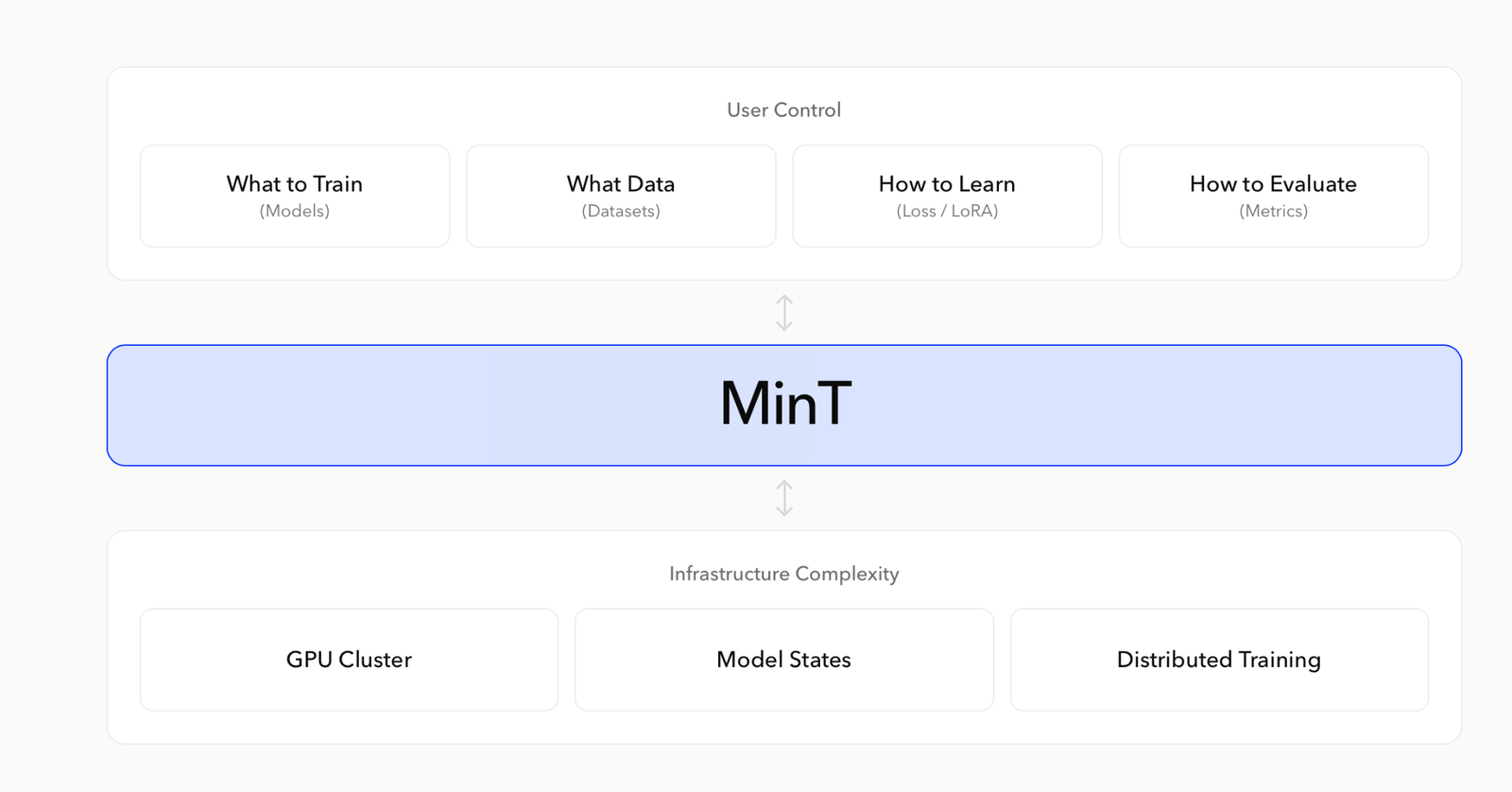
You choose the base model and training algorithm, and define the data, loss function, and reinforcement learning environment. The Python SDK sends computation to remote resources, so you do not need a local GPU. The platform handles scheduling, sharding, fault recovery, scaling, and operations.
Changing a training plan does not require rebuilding a distributed system. You can focus on what the business has learned: which examples are worth learning from, how to assess an output, and what the next round needs to address.
How LoRA supports serverless training and deployment
Mint Recursive supports full-parameter post-training and uses LoRA to support serverless training and deployment. Different business use cases and experiment branches keep their training results in lightweight adapters over the same base model. Each adapter can be trained, revised, and deployed independently.
During training, LoRA updates only a small set of added parameters. This reduces storage and communication costs and avoids saving a complete set of model weights for every branch. Compare evaluation results before and after training to measure changes in performance on the business task.
During deployment, adapters share a single base model and are loaded separately. Each can be evaluated, deployed, or withdrawn on its own. Earlier versions can be kept for comparison and rollback. When a standalone model is needed, an adapter can be merged into the base weights to produce a complete model.
With this managed service, you focus on training jobs, evaluation results, and releases; the platform handles the underlying resources. Serverless training and inference are billed by actual token usage. See Service Pricing for the billing items and rates.
From post-training research to a managed service
In 2025, Mind Lab began post-training research on trillion-parameter models such as Kimi K2. Work on the infrastructure behind Mint Recursive began at the same time. Our LoRA RL research on Kimi K2 demonstrated that this approach could work at that scale.
In July 2026, we released the Macaron-V1 series, further validating the training approach on tasks such as agent work and coding. We are now opening the system as a platform service so businesses can use their domain experience in model training and test the results in practice.
Getting started
Start with the Python SDK quickstart, or use the Mint Recursive console to complete a round of training and evaluation. Use mintcn.macaron.xin in mainland China and mint.macaron.im in other regions.
Mint Recursive's training API is compatible with Tinker. We also provide a Claude Code migration Skill to help adapt training code built with verl, TRL, OpenRLHF, or a custom PyTorch loop to the Mint Recursive API.
For the scope and pricing of Training API, Inference API, and LLM as a judge services, see Service Pricing. For dedicated inference or a discussion of your requirements, contact sales.